Work Begins at Four New Schools

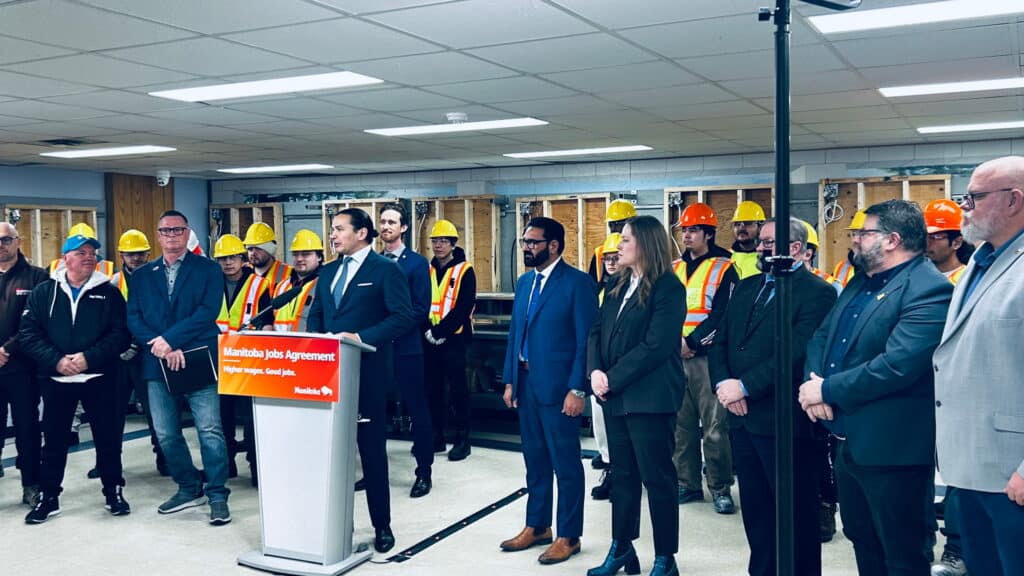
Construction has officially begun on four new schools under the Manitoba Jobs Agreement (MJA), marking a significant step forward in how public infrastructure is delivered in Manitoba.
The projects — located in Winnipeg’s Devonshire Park and Prairie Pointe neighbourhoods, West St. Paul’s Meadowlands neighbourhood, and southwest Brandon — are moving ahead less than one year after being announced. All four schools will be built simultaneously using a standardized design.
Manitoba Jobs Agreements are a procurement and workforce framework designed to ensure that public infrastructure delivers clear public benefits. Under the MJA model, major projects prioritize Manitoba workers, support apprenticeship training, and establish consistent expectations around wages, benefits, safety, and site conditions for both union and non-union contractors.
Today’s announcement demonstrates that MJAs support fair and competitive bidding. There was strong interest in the school projects, with contracts awarded to both union and open-shop contractors, including Manitoba-based companies. This reflects the intent of the MJA framework: set clear rules up front and allow competition to function within those expectations.
Speaking at today’s press conference, Manitoba Building Trades Executive Director Tanya Palson emphasized the importance of bringing workers into project planning from the outset.
“For the first time, workers are being considered at the very start of how public projects are planned and delivered,” said Palson. “Manitoba Jobs Agreements make sure local workers, apprentices, and workforce stability aren’t an afterthought — they’re built into the project from day one.”
Palson also highlighted the role Manitoba Building Trades plays in ensuring MJAs deliver results in practice.
“Our role is to ensure that workforce commitments around local hiring, apprenticeship opportunities, and working conditions are actually followed through on site,” she said. “Without enforcement and representation, workforce commitments are just promises. With them, they become outcomes.”
While MJAs represent a change from past procurement approaches, they reflect a standard model used across Canada, the United States, and internationally to reduce project risk, improve safety, and support long-term workforce development.
“For years, skilled tradespeople sat on the out-of-work list while public projects failed to deliver stable local employment,” said Palson. “MJAs turn public investment into real jobs, real training, and long-term workforce capacity for this province.”
The Manitoba government has indicated that MJAs will be used on additional major projects, including the Victoria emergency room redevelopment.
Manitoba Building Trades will continue working with project partners to ensure workers remain central to project delivery and that public infrastructure investments deliver lasting benefits for Manitoba communities.